
Barton Projected and Actual Release
A projected date is a calculation or planned event. An actual release date records when a custodian’s control ended. The two can differ because credits change, a judgment is amended, the Parole Board acts, or another agency has a detainer. A detainer is a request to hold or transfer a person for another matter. Release to that agency is not a community release.
Pretrial custody works differently. No sentence has yet supplied a term to calculate. A bond order may authorize release if its requirements are met, but the order does not prove payment or physical exit. A dismissal can end one charge while another hold remains. Ask the Barton County Sheriff or actual outside holding jail for the last custody transaction, and compare it with Case.net.
- Minimum release date
- A calculated minimum on an active sentence, not an unconditional promise.
- Maximum release date
- The sentence-expiration calculation shown in the historical data.
- Conditional release
- A supervised portion of a qualifying sentence served after leaving prison.
- Final discharge
- The later end of the sentence or supervision.
Look Up Barton Release Dates
First identify the custodian. A Barton arrest may stay local, move to an outside jail under the Lamar municipal arrangement, reach MODOC after sentencing, or enter federal or immigration custody. No single date system covers all those paths. Use identity details beyond a name, such as a case, booking, DOC, or federal register number.
- Check Barton Case.net for judgment, sentence, jail-credit language, bond or dismissal orders, and concurrent or consecutive terms.
- For state custody, open the MODOC active offender search. Match the DOC ID, birth date, offense, county, and assigned place.
- Determine whether the assignment is institutional or in the field. Field supervision may support release on parole or conditional release.
- Use the MODOC Sunshine data page for the exact minimum and maximum labels, especially for an older or discharged record.
- Ask MODOC Constituent Services to identify whether a date is minimum eligibility, Board-approved release, actual institutional release, conditional release, or final discharge.
- For a county sentence, contact the Sheriff, actual holding jail, and Circuit Clerk. Barton publishes no county-jail date calculator or good-time policy.
The Barton released-inmate search provides the broader route when the custody system is unknown. Federal BOP, USMS, and ICE events require their own agency and court checks.
Barton MODOC Release Date Fields
Missouri’s verified public labels are “Sentence-I Minimum Release Date” and “Sentence Maximum Release Date.” The interactive search does not promise a generic projected-release box and excludes discharged offenders. The nightly Sunshine file is charge-level, so one person may have several rows. Group them by lifelong DOC ID before drawing a conclusion.
| Field | Meaning and limit |
|---|---|
| Sentence-I Minimum Release Date | Calculated minimum on the active sentence, not a guaranteed exit date. |
| Sentence Maximum Release Date | Maximum sentence calculation, which is not the same as final discharge in every context. |
| Completed flag | Y means that charge-level sentence is completed; other rows may remain open. |
| Field/institution marker | Helps distinguish community supervision from institutional assignment. |
| Assigned place | Identifies the institution or field assignment used to interpret status. |
| Sentence county | BART identifies Barton in the official data. |
The official historical data explanation documents these fields and cautions.
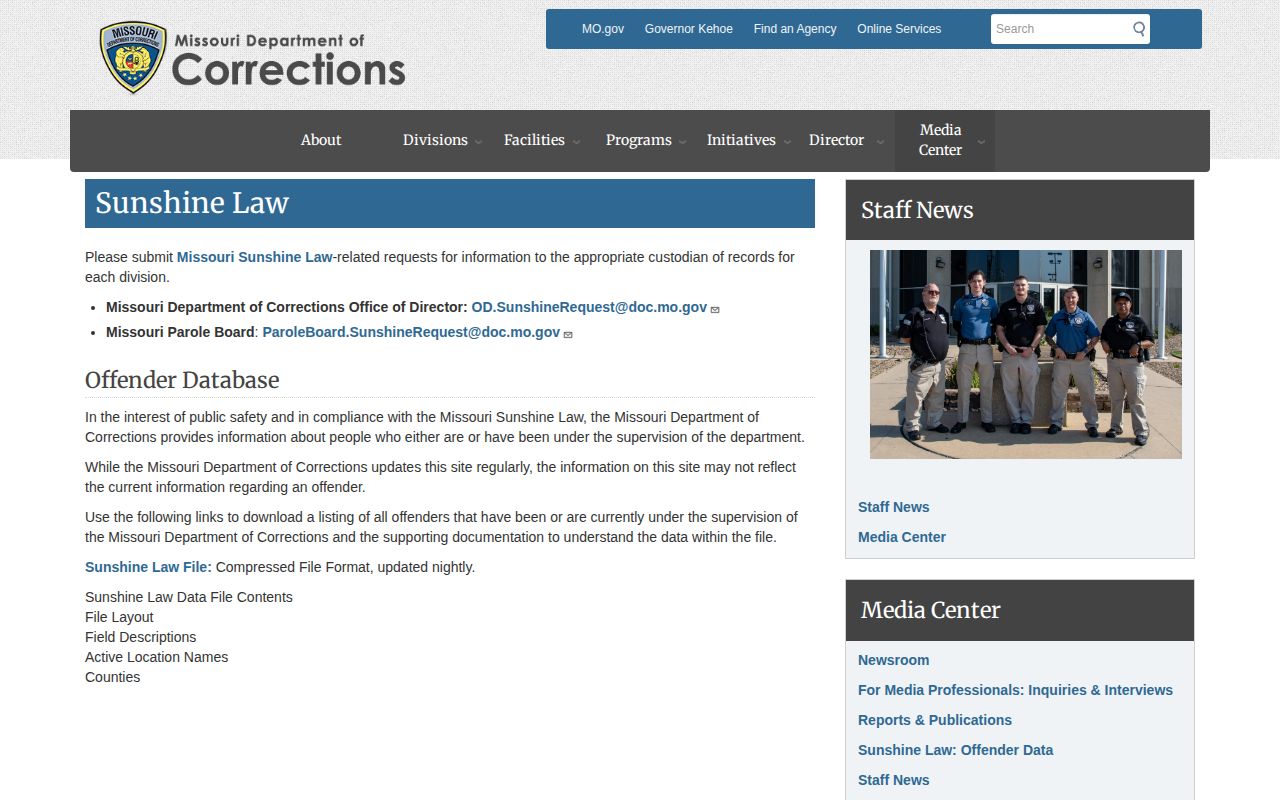
The field layout is the correct source for date labels. It must be read with the completed flag, location marker, assigned place, and all rows for the same DOC ID.
Barton Release Date Special Values
The historical file also uses numeric placeholders that are not calendar dates. A value of 99999999 represents life. The value 88888888 marks indeterminate or interstate records. The value 66666666 appears for certain field assessment or investigation records. Converting any of these into a date would create a false result.
Historical data carries broader cautions. MODOC describes it as a working file, warns about completeness and accuracy, and notes system conversion and self-reported information. Its history can extend back to 1974, while the current system dates from a later conversion. Record the nightly file date and seek agency confirmation when an individual date matters.
This is the distinctive Barton release-date issue: the active search is useful for a person who remains incarcerated or supervised, but it is the wrong final-discharge tool by design. A no-result may mean discharge, an exclusion, spelling mismatch, timing, or no MODOC jurisdiction. The historical file and a focused status request supply the next step.
Barton Sentence Credit Rules
Missouri release calculations combine several rules. Under section 558.031, qualifying custody tied to the offense can count before the prison sentence begins, based on sheriff certification. This jail credit can make the agency calculation earlier than simply adding the pronounced term to the date of MODOC arrival.
Section 558.011 generally divides qualifying non-dangerous-felony terms into prison and conditional-release portions. For terms of nine years or less, one-third is generally conditional release. For more than nine through fifteen years, the conditional-release portion is three years. For more than fifteen years, it is five years. The prison term is the balance. Conditional release still involves supervision and can be extended under applicable law.
Section 558.041 permits discretionary additional confinement credit on the superintendent’s recommendation under DOC policy for conduct or program participation. It is not an automatic daily deduction. Credit can be lost for violations. Missouri Earned Compliance Credits are different: they concern community supervision and possible early final discharge, not prison good time.
Never estimate one person’s date from sentence length alone. The judgment, certified jail credit, concurrent or consecutive structure, offense date and class, conduct record, Board action, and any new case or detainer all matter.
Barton Dangerous-Felony Release Minimum
Section 558.019 requires a person committed for a statutorily defined dangerous felony to serve 85 percent before parole, conditional release, or another early MODOC release, subject to the statute’s age-70 and 40-percent provision. Life is treated as thirty years for this calculation, while certain aggregate sentences above seventy-five years are treated as seventy-five.
The rule does not apply to every Missouri prisoner. Do not label an offense “dangerous” from ordinary language or apply 85 percent to all convictions. Confirm the statutory classification, offense date, judgment, and sentence structure. Then ask MODOC how the rule affects the public minimum and the person’s eligibility.
The official dangerous-felony provision is the source for the limited 85-percent rule.
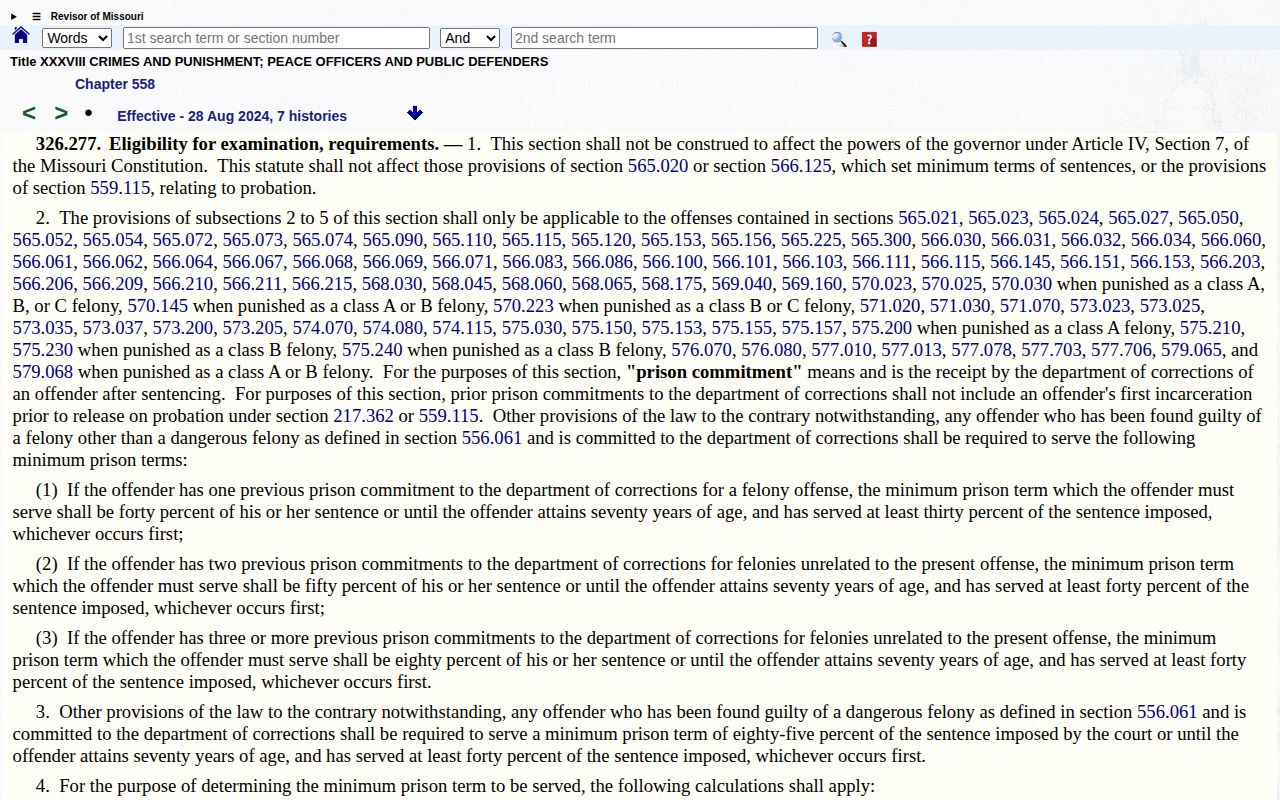
The statute supports a classification-specific minimum. It does not provide a stand-alone calculator for an individual Barton County sentence.
Why Barton Release Dates Change
A date can move even after an initial calculation appears. Treat every date as having a type and source. A court judgment, MODOC calculation, Board decision, and facility movement record may update at different times.
| Factor | Possible effect | Where to confirm |
|---|---|---|
| Certified jail credit | Moves the calculation based on qualifying pre-sentence custody. | Judgment, sheriff certification, and MODOC |
| Concurrent or consecutive terms | Changes whether terms overlap or run one after another. | Case.net judgment and MODOC calculation |
| Good-time award or loss | Can shorten or extend confinement within the lawful framework. | MODOC public calculation or status response |
| Parole Board action | May grant, deny, defer, condition, reconsider, or rescind release. | Public Board decision and institutional staff |
| Amended order or corrected data | Changes the legal or administrative calculation. | Court docket and MODOC |
| New case or detainer | May lead to transfer or continued custody after one term ends. | Holding agency, court, and receiving custodian |
No Barton county-jail good-time, weekend-release, holiday-release, or fixed exit-time policy was verified. The Lamar agreement’s example touching two billing days is only an intergovernmental accounting example. It does not promise a release time or show how county confinement is calculated.
Confirm Barton Release Dates
For a state prisoner, contact MODOC Constituent Services at 573-526-2695 or constsrv@doc.mo.gov. Ask staff to distinguish the Sentence-I Minimum Release Date, Sentence Maximum Release Date, parole or conditional-release date, actual institutional release, and final discharge. For a Board decision, use the Missouri Parole Board and its records custodian.
For a Barton County jail event, call the Sheriff at 417-682-5515. Ask whether the person was booked, housed onsite or elsewhere, and whether the latest movement was community release, transfer, or court transport. If another jail held the person, that jail owns the final movement record. The Barton Circuit Clerk can supply the judgment, release order, dismissal, jail-credit certification, or other filed disposition, but not a live gate-exit time.
A pending alert through the Barton VINE inmate check can report a participating custody change. MOVANS may lag or a local jail may be offline. Preserve the alert and confirm its meaning with the custodian. For federal or immigration cases, use the relevant BOP, actual federal holding facility, federal court, USMS, or ICE route.
Use precise conclusion language. State that an agency calculated, approved, or recorded a particular date. If the record says transfer, name the receiving system when known. Only the actual custody record can establish the completed movement from that facility.