
Barton Federal Release Paths
Federal custody can begin without a federal prison assignment. The U.S. Marshals Service manages many pretrial and remand prisoners and can use contracted state or local facilities. BOP generally becomes the public locator once a sentenced person is designated into its system. That difference matters when someone vanishes from local custody. A pickup by federal authorities is a transfer, not a community release.
No federal prison was verified inside Barton County. The inquiry is therefore system-based. Ask the Barton County Sheriff whether the last county event was a release, court transport, or federal transfer. Obtain the destination when it can be disclosed. Then use the federal case docket and the actual holding agency to follow the custody chain.
Confirm a Federal Inmate Release
Use the narrowest available identifier. A BOP register number is stronger than a name alone. When the register number is unknown, compare the person’s full name, age, race, sex, case, and dates. Follow this order:
- Ask Barton for the last custody transaction and receiving agency if the person was first held locally.
- Read the federal court docket for detention, sentencing, transfer, and supervised-release context.
- Search the BOP Inmate Locator by register number or name and the available identity filters.
- Record the exact location, release-date display, and wording such as “Released” or “Not in BOP Custody.”
- Check any state, county, or immigration hold separately before describing the person as in the community.
The BOP result is one piece of evidence. A federal docket can explain the sentence and later supervised-release term, but it is not a live gate log. The holding facility records the actual departure. When the person never entered BOP designation, the facility and USMS or court records may be the only useful route.
BOP Federal Release Search Fields
The BOP locator covers federal inmates within its published historical range and shows a compact set of public fields. Results can include name, register number, age, race, sex, release date, and location. “Released” means departure from BOP custody. “Not in BOP Custody” also describes bureau custody, not every other jurisdiction.
| BOP Field | How to Read It |
|---|---|
| Register number | Primary federal identity number for matching the record |
| Name and identity fields | Help separate people with similar names |
| Location | Shows a bureau facility or a status label |
| Release date | BOP's date for its custody event, not the end of every legal restraint |
| Released status | Confirms the person is no longer held by BOP |
Use the official BOP search interface rather than a commercial inmate page.
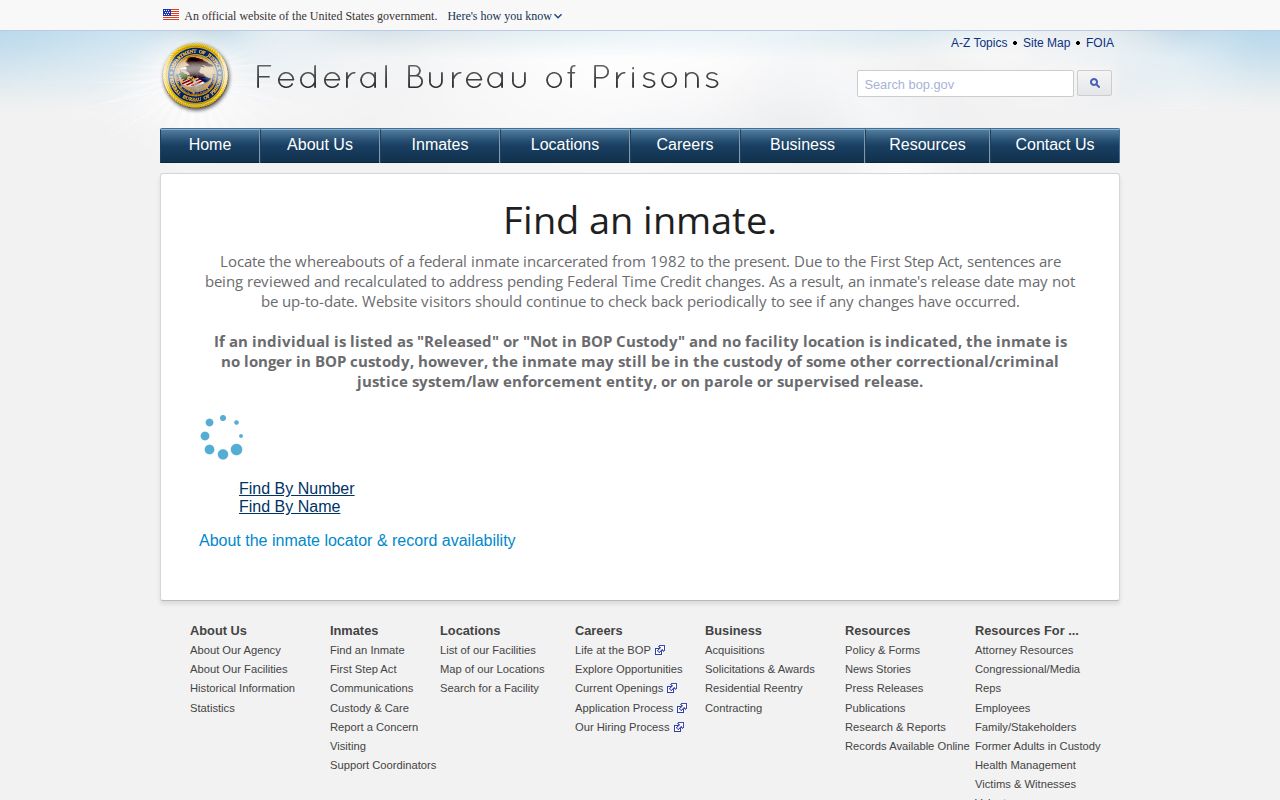
Keep the result date and search date together. Release information can be updated, and a scheduled date is not always the same as the final event. If the result is unclear, ask BOP for the public release record and compare it with the court docket.
What Federal Release Does Not Prove
A BOP release date does not prove that the person returned to Barton County. The person could enter another sovereign’s custody, face immigration detention, or begin a term of supervised release. The words on the BOP record must stay tied to BOP. A safe conclusion is that the person left Bureau of Prisons custody on the listed date.
County and state systems are separate. MODOC will not ordinarily document a federal prison release unless Missouri also has jurisdiction. MOVANS does not replace BOP. The Missouri registry applies only to people who must register. ICE has its own recent-custody tool. Search each system only when the case facts point there.
Scope matters. “Released by BOP” is not the same statement as “free from all custody.”
Barton Federal Pretrial Custody
The U.S. Marshals Service does not provide a public historical release locator comparable to BOP. It can hold prisoners at contracted facilities before trial, after a remand order, or while transport is arranged. A person can therefore leave Barton custody for federal detention and still produce no BOP locator result.
For that path, start with the actual holding jail and federal docket. Ask the jail whether its final entry was transfer, release on a court order, or transport. The USMS prisoner-operations page explains the agency’s custody role but does not supply person-by-person results. The Western District of Missouri office may provide routing information when a lawful public inquiry cannot be resolved through the docket or custodian.
Do not infer release from a missing BOP result. The person may never have been designated to BOP, the name may differ, or the event may fall within a different agency’s record. A direct request should name the person, case number, approximate dates, and known holding facility.
Federal Release Records and Contacts
For a sentenced federal prisoner, ask BOP for the public record that states the actual release date, status, and institution. Include the register number. For a pretrial prisoner, direct the request to the physical holding facility and, as needed, USMS. The federal court clerk can provide filed detention, release, sentence, and supervised-release orders. Those orders explain authority, while the custodian records movement.
Federal sentenced-prisoner search
BOP Inmate Locator
Facility address, phone, and hours depend on the result and are not published in the Barton research.
Federal pretrial context
U.S. Marshals Service, Western District of Missouri
The actual holding facility must supply its own address, phone, and access hours.
Ask for existing records instead of asking an agency to create a new narrative. A focused request can seek admitted and departed timestamps, release or transfer disposition, receiving authority, and any public detainer notation. If part of the record is withheld, ask the custodian to identify the authority for the closure or redaction.
Preserve the response with the locator result and docket entry. These records can use different terms for the same period, and the dates may reflect filing, transport, admission, or departure rather than one shared moment. If the agency supplies only a scheduled date, ask whether it later changed and whether an actual release transaction exists. For an older event, state the years requested so the custodian can search the right system. A one-person request should list known name variants because federal records may use a middle name, suffix, or spelling that differs from the Barton booking.
Cross-Check Barton Federal Releases
A strong confirmation uses at least two sources. Barton’s record shows how county control ended. The federal source shows what happened next. A matching court order can explain the legal basis. Keep timestamps separate because a county departure, federal admission, docket entry, locator update, and notification can occur at different times.
If the person was released by BOP but another hold is possible, contact that jurisdiction. If immigration custody is suspected, use the ICE channel. If Missouri custody follows, check MODOC. The Barton County release search provides the county, state, federal, and immigration decision path without treating one locator as universal.
Identity is part of the cross-check. Compare the federal register number and case number, not just the person’s name. Note the source, status wording, and time checked. If the Barton and federal records point to different people or dates, pause the conclusion and ask the custodians to correct or explain the mismatch.
An old federal event requires a different emphasis from a live search. BOP is the public locator for federal prisoners from its stated historical period forward. A USMS event has no matching public historical locator. Use the federal docket and direct records path for pretrial custody, and use the holding facility for its own release or transfer log. If the person left BOP for another authority, obtain that receiving authority’s later event before closing the custody timeline.
Do not merge a federal result with a Barton court result merely because the names match. Compare the federal register number, the federal case number, the Barton case number, identity fields, and dates. A Barton criminal record can remain visible after federal custody ends. Likewise, a BOP result says nothing about a separate Missouri case unless the records themselves connect the two.